What Euro Standard Is My Car?
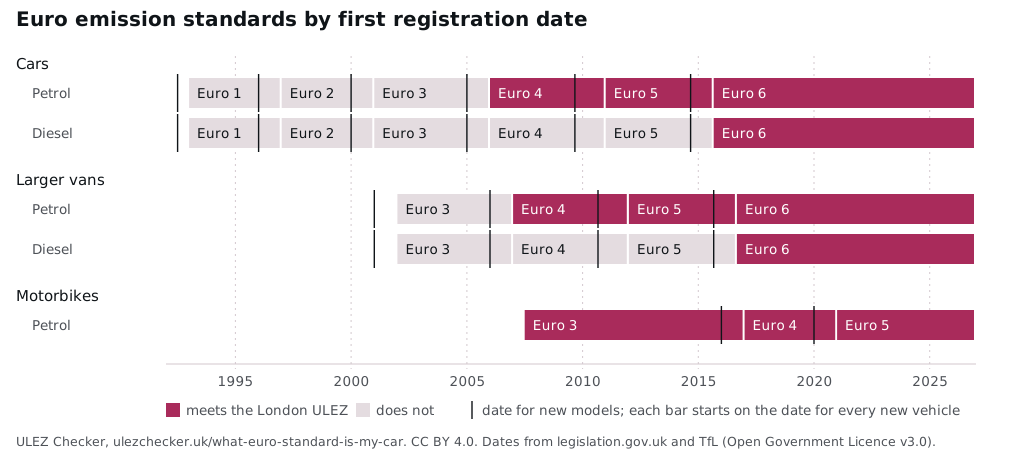
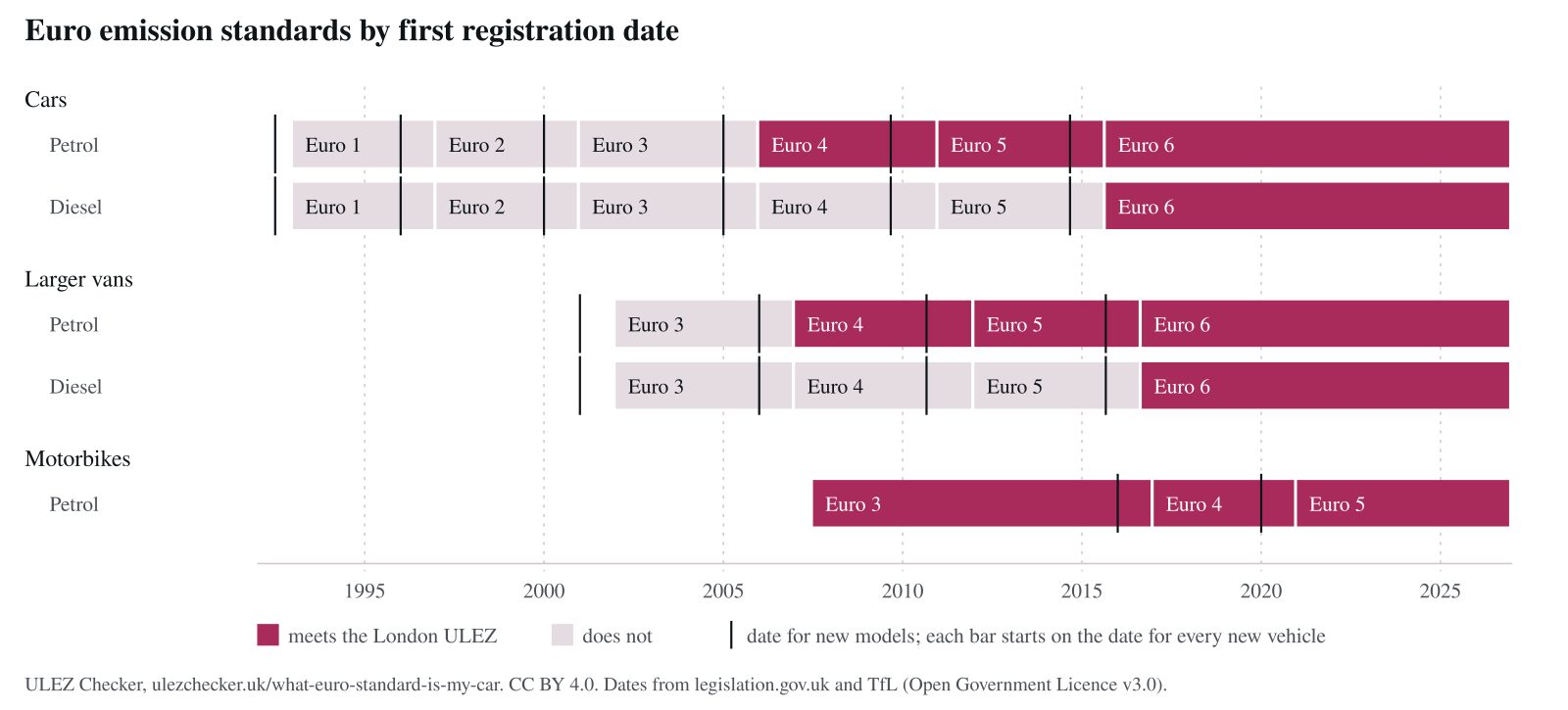
To work out what euro standard is my car, begin with the first registration date: new petrol cars registered from 1 January 2006 meet Euro 4, and new diesels registered from 1 September 2015 meet Euro 6.
Each standard first covered new models, then every new car, so many models met it a year or more earlier. End-of-series exemptions let a few older-standard cars be registered after the date, so the V5C logbook or the manufacturer has the final word.
ULEZ Euro 4 and Euro 6: what each zone asks for
Under London's ULEZ, petrol cars and vans need Euro 4, diesel cars and vans need Euro 6, and motorbikes and mopeds need Euro 3.
England's clean air zones set the same limits for cars and vans: Euro 4 for petrol, Euro 6 for diesel. Private cars get charged only where the zone is class D, and none of the current zones charge motorbikes.
Any vehicle that isn't fully electric pays in Oxford's zero emission zone. Euro 4 petrol and Euro 6 diesel vehicles get a cheaper daily rate.
In Scotland's low emission zones, petrol cars and vans need Euro 4 and diesel ones Euro 6, while motorbikes and mopeds are exempt.
Euro standard dates by year
The start of a bar is the date the standard became the rule for all new vehicles. The short upright line before it is the date it started applying to new models. So the ULEZ accepts most petrol cars from 2006 and most diesels from September 2015.
ULEZ compliant years for every Euro standard
Cars
| Euro standard | New models from | Every new vehicle from | London ULEZ | Clean air zones |
|---|---|---|---|---|
| Euro 1 | 1 July 1992 | 31 December 1992 | No | No |
| Euro 2 | 1 January 1996 | 1 January 1997 | No | No |
| Euro 3 | 1 January 2000 | 1 January 2001 | No | No |
| Euro 4 | 1 January 2005 | 1 January 2006 | Petrol only | Petrol only |
| Euro 5 | 1 September 2009 | 1 January 2011 | Petrol only | Petrol only |
| Euro 6 | 1 September 2014 | 1 September 2015 | Petrol and diesel | Petrol and diesel |
For Euro 3 and Euro 4, the larger van dates also covered cars over 2,500 kg maximum mass, examples being some 4x4s and some large people carriers.
Small vans (N1 class I)
N1 class I is the small van group, weighing no more than 1,205 kg unladen, and its dates match the cars. Vans in N1 class II and III, which go up to 3.5 tonnes, picked up each standard a year after cars. So a large diesel van usually needs to have been first registered on or after 1 September 2016.
| Euro standard | New models from | Every new vehicle from | London ULEZ | Clean air zones |
|---|---|---|---|---|
| Euro 3 | 1 January 2000 | 1 January 2001 | No | No |
| Euro 4 | 1 January 2005 | 1 January 2006 | Petrol only | Petrol only |
| Euro 5 | 1 September 2009 | 1 January 2011 | Petrol only | Petrol only |
| Euro 6 | 1 September 2014 | 1 September 2015 | Petrol and diesel | Petrol and diesel |
Larger vans (N1 class II and III)
| Euro standard | New models from | Every new vehicle from | London ULEZ | Clean air zones |
|---|---|---|---|---|
| Euro 3 | 1 January 2001 | 1 January 2002 | No | No |
| Euro 4 | 1 January 2006 | 1 January 2007 | Petrol only | Petrol only |
| Euro 5 | 1 September 2010 | 1 January 2012 | Petrol only | Petrol only |
| Euro 6 | 1 September 2015 | 1 September 2016 | Petrol and diesel | Petrol and diesel |
Motorbikes and mopeds
Standards for motorbikes came later and follow dates of their own. TfL says most bikes registered with the DVLA after July 2007 meet Euro 3.
| Euro standard | New models from | Every new bike from | London ULEZ |
|---|---|---|---|
| Euro 3 | Not set | July 2007, TfL's guide | Yes |
| Euro 4 | 1 January 2016 | 1 January 2017 | Yes |
| Euro 5 | 1 January 2020 | 1 January 2021 | Yes |
Registered near a changeover date
A standard reached new models before it reached every new car. In that gap, cars were sold under both the older and the newer standard. A first registration in that window, or one covered by an end-of-series exemption, means you should consult the manufacturer or the V5C logbook's section D.2. After that, verify it with TfL's official checker.
The Euro 6 checker lets you check by number plate instead.
Where the dates come from
The car and van dates come from EU rules that UK law kept and legislation.gov.uk publishes: Directive 91/441/EEC for Euro 1, Directive 94/12/EC for Euro 2, Directive 98/69/EC for Euro 3 and Euro 4, and Regulation 715/2007 for Euro 5 and Euro 6. Only cars are shown for Euro 1 and Euro 2. For the motorbike dates, the sources are TfL for Euro 3 and Regulation 168/2013 for Euro 4 and Euro 5. TfL sets the ULEZ limits, and the government's Clean Air Zone Framework sets the clean air zone limits. When two standards could both apply to a vehicle, play safe: go by the date the newer one covered every new vehicle.
Contains public sector information licensed under the Open Government Licence v3.0.
Euro dates: common questions
Is my 2015 diesel car Euro 6?
Almost certainly, provided its first registration was on 1 September 2015 or later. Between 1 September 2014 and 31 August 2015, a first registration could mean either Euro 5 or Euro 6. Check section D.2 of the V5C, since it depends on the model.
Are Euro 4 petrol cars ULEZ compliant?
Yes. All three accept Euro 4 petrol cars: London's ULEZ, England's clean air zones and Scotland's low emission zones. That covers most petrol cars registered new from 2006, and many from 2001.
Is a 2010 diesel ULEZ compliant?
No. Every new car only had to meet Euro 5 from 1 January 2011, so many diesels with a 2010 first registration are Euro 4, and some models from 2010 already met Euro 5. The ULEZ asks a diesel for Euro 6, so neither one qualifies.
Download the chart (SVG, JPG) and the table (CSV). You may share the chart and table under CC BY 4.0: name ULEZ Checker and link back here.